

24th December 2024 – (Hong Kong) Hong Kong’s Secretary for Security Chris Tang announced comprehensive measures against six new individuals, marking a continued effort by the government to clamp down on those it accuses of endangering national security. This announcement follows closely on the heels of earlier sanctions against seven notable figures, including activist Ted Hui and legislator Dennis Kwok.
The individuals newly named include Carmen Lau Ka-man, Tony Chung, Chung Kim-wah, Victor Ho, actor Joe Tay, and Cheung Hei-ching. These figures, now categorised as fugitives, are subject to a HK$1 million bounty each for information leading to their arrest, highlighting the seriousness with which the government is pursuing these cases.
Steve Li Kwai-wah announced the addition of six individuals to the National Security Department’s wanted list. He reported that Carmen Lau Ka-man, using her role in the Hong Kong Democracy Council, has been actively promoting the secession of Hong Kong from China online and lobbying foreign governments to impose sanctions on China and Hong Kong, such as abolishing the special privileges of the Hong Kong Economic and Trade Offices. Tony Chung was previously imprisoned for secession and money laundering charges, deceived the Correctional Services Department by travelling without returning to Hong Kong, and continues to advocate for Hong Kong independence through platforms like the Hong Kong Independence Commission overseas. Chung Kim-wah has been inciting secession and colluding with foreign forces, using various platforms between May and June 2024 to promote Hong Kong independence and encourage foreign sanctions against China and Hong Kong, including calls to shut down the Economic and Trade Offices. Victor Ho, in July 2022, used different platforms to push for Hong Kong’s self-determination and autonomy through electoral referendums.
Joe Tay is implicated in calling for sanctions against related officials. Cheung Hei-ching, starting from August 2022, has been promoting Hong Kong independence through The Committee for Freedom in Hong Kong Foundation and has been actively lobbying for foreign countries to impose sanctions on Hong Kong during this period.
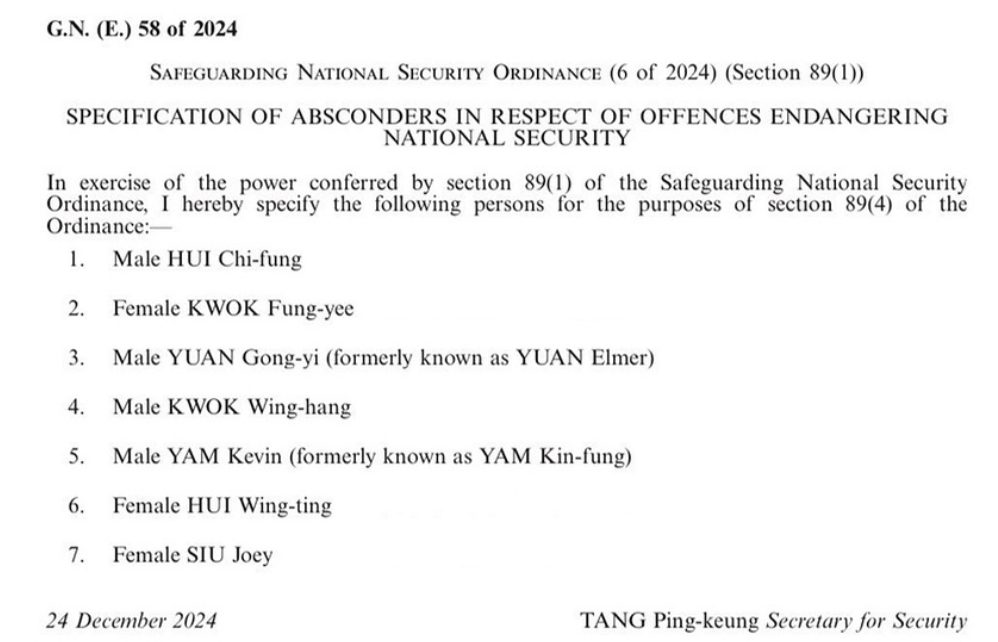
Earlier this morning, Hong Kong revoked the passports of seven fugitives, including activist Ted Hui Chi-fung, and prohibited anyone from providing them with funding, marking the second instance under the city’s national security law. The government, led by Secretary for Security Chris Tang Ping-keung, identified these individuals as absconders for offences threatening national security and outlined several measures against them, including the cancellation of their passports and restrictions on financial transactions, real estate activities, and partnerships with these fugitives. Additionally, former Legislative Councillors Ted Hui and Dennis Kwok, along with lawyer Kevin Yam, face suspension of their legal qualifications, while activist Elmer Yuan has been temporarily removed from directorships in local companies.
Chris Tang, in a press briefing, detailed the actions that have been taken against these individuals, which include the prohibition of providing or dealing with funds and immovable property, and the involvement in joint ventures or partnerships. Additionally, the Hong Kong Special Administrative Region (HKSAR) passports of the accused have been revoked, and in certain cases, professional qualifications have been suspended and directorial positions have been temporarily removed.
These measures are part of a broader strategy to thwart what the government describes as attempts to split the country and implement self-determination initiatives through unsanctioned reports and meetings with foreign politicians. Tang accused some of the individuals of colluding with foreign politicians and fabricating documents to flee overseas, which he said constituted a direct threat to national security.
The Secretary for Security also stated that the Department of Justice is moving to confiscate any criminal proceeds gained through online platforms by these individuals. This step underscores the government’s commitment to cutting off financial resources believed to be used in activities that threaten the state’s stability.
Furthermore, Tang emphasised the legal consequences of assisting or being involved with the named fugitives. He warned that providing direct or indirect funding, including through online platforms, renting out an immovable property, or forming joint ventures with these individuals, is now a criminal offence punishable by up to seven years in prison. This stern warning serves as a deterrent aimed at preventing the public from inadvertently becoming entangled in legal violations.
This robust approach follows earlier actions in June when similar measures were imposed on six other fugitives, including Nathan Law and unionist Mung Siu-tat. These continuing efforts indicate a clear pattern in the government’s strategy to utilise the National Security Law to its full extent to address what it perceives as threats emanating from dissident activities, both domestically and abroad.