25th December 2024 – (Hong Kong) Recent statistics in Hong Kong reveal a striking disparity, with 107 billionaires residing in the city while nearly 1.4 million residents live below the poverty line. While the wealthiest 10% of households command a median monthly income of HK$131,000, the poorest 10% subsist on a mere HK$1,600. That’s an 81-fold difference in a city smaller than most American counties. Yet both the taipan in his Peak mansion and the elderly woman collecting cardboard in Sham Shui Po face the same inevitable destination.
The numbers tell a story of two Hong Kongs existing in parallel universes. While 619,000 households struggle below the poverty line – representing an astonishing 22.7% of all households – the city maintains its position as the world’s second-largest concentration of billionaires after New York. This isn’t just inequality; it’s a moral failure of epic proportions.
Particularly striking is the plight of our elderly. Over 580,000 residents aged 65 or above live in poverty, a 42.9% increase from 2019. These are the people who built our city, now reduced to collecting refuse or working security jobs well past retirement age. Their twilight years are spent in hardship while others inherit fortunes larger than some countries’ GDP.
Yet death cares nothing for net worth statements or property portfolios. As Marcus Aurelius noted, both Alexander the Great and his mule-keeper faced the same end. Our billionaires’ Ferrari collections and art investments won’t follow them into the grave. Their children may inherit their wealth, but they too will face the same equalizing force.
The irony of Hong Kong’s wealth disparity becomes particularly acute during festive seasons, when luxury retailers report record sales while food banks struggle to meet surging demand. A single dinner at a Michelin-starred restaurant in Central often exceeds what a poor family spends on food in a month. Yet both the diner savouring his HK$12,000 wine and the elderly woman counting coins for her char siu fan share one unchangeable destiny.
Our city’s obsession with material success has created a peculiar form of collective madness. Property developers build ever-smaller “nano flats” while maintaining some of the highest profit margins globally. The average Hong Konger needs to save 23.2 years of their entire income, without spending a dollar, to afford a modest flat – the most unaffordable housing market worldwide for 13 consecutive years.
Consider the mathematics of inequality: The combined wealth of Hong Kong’s ten richest individuals exceeds HK$1.2 trillion, while nearly a quarter of our population lives in public housing. This concentration of wealth would be concerning enough in isolation, but it’s the velocity of the divergence that should alarm us. The gap between rich and poor has widened more in the past decade than in the previous thirty years combined.
The pandemic highlighted this divide. While some Hong Kongers retreated to second homes overseas, others were confined to subdivided flats smaller than prison cells. COVID-19 didn’t discriminate between rich and poor, just as death doesn’t – yet our society’s response to the crisis certainly did.
What’s particularly galling is how this inequality has become normalised. We’ve developed an elaborate social mythology to justify it: the poor aren’t working hard enough, the rich earned their success, social mobility is just a matter of determination. Yet studies consistently show that social mobility in Hong Kong has decreased significantly over the past two decades.
The statistics reveal a troubling reality, with the richest 1% owning 70% of the city’s wealth, median household income stagnating despite a doubling of GDP per capita, youth unemployment in disadvantaged districts reaching three times that of affluent areas, and life expectancy differing by as much as five years between rich and poor neighbourhoods.
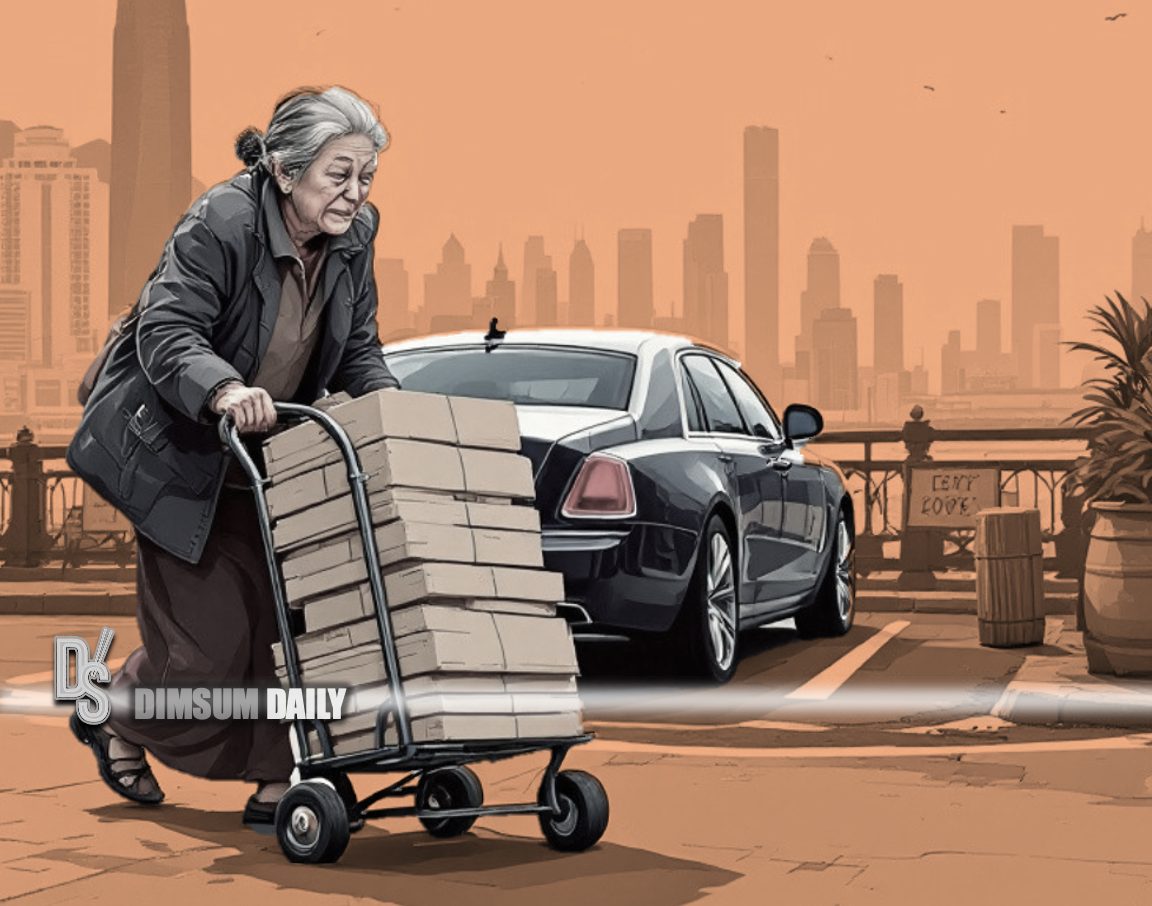
Despite having the world’s highest concentration of Rolls-Royces per capita, Hong Kong also has elderly people collecting cardboard at midnight to earn enough for breakfast. Both the Rolls-Royce owner and the cardboard collector will end up in the same place – though one might have a more elaborate journey getting there.
The implications for Hong Kong’s social fabric are profound. Our city has become a laboratory experiment in extreme capitalism, where the distance between penthouses and cage homes grows wider by the day. Yet death remains stubbornly egalitarian, caring nothing for the trappings of wealth or status that consume our living hours.
Recent surveys reveal a troubling zeitgeist: 76% of young Hong Kongers believe they’ll never own a home, while 82% of respondents across all age groups report feeling “trapped” in their current economic situation. The psychological toll of this inequality manifests in concerning ways – Hong Kong’s suicide rate among elderly citizens is nearly triple the global average.
The wealthy, meanwhile, appear increasingly disconnected from this reality. Private school enrolments have surged 40% in five years, creating parallel education systems. Private members’ clubs report waiting lists despite initiation fees exceeding HK$2 million. The rich literally breathe different air, with premium air purification systems in luxury developments while subdivided flat dwellers endure some of the worst indoor air quality in the developed world.
Yet history teaches us that such extreme inequality carries seeds of its own destruction. Ancient Rome’s wealth gap preceded its fall. The French Revolution was preceded by similar levels of inequality. While Hong Kong’s stability has proved remarkable, the question isn’t if such disparities are sustainable, but for how long.
The contrasts are striking, as a luxury house on the Peak can sell for HK$255,000 per square foot, while some individuals reside in cramped 60-square-foot subdivided units. In private hospitals, maternity packages can exceed a low-income family’s annual income, and while some children attend schools with annual fees surpassing HK$300,000, others are educated in converted shipping containers. Additionally, monthly parking spaces in Central can cost more than the median salary.
The absurdity reaches its apex in death itself. While the wealthy plan elaborate columbariums costing millions, the poor struggle to afford basic funeral services. Yet the ashes of both will return to the same earth.
The cruel irony is that this pursuit of wealth often comes at the expense of what makes life worth living. Studies show that beyond meeting basic needs, additional wealth correlates poorly with happiness. Many of our city’s wealthy are trapped in gilded cages of their own making, working punishing hours to maintain lifestyles that offer diminishing returns in actual life satisfaction.
As we approach 2025, we can continue down this path of extreme inequality, pretending that the suffering of the poor is somehow disconnected from the excess of the rich. Or we can acknowledge that in a city where death remains the great equalizer, perhaps we should strive for more equality in life as well.
The choice is ours, but time isn’t on our side. Every day, both billionaires and street cleaners meet their end, their bank balances suddenly irrelevant. Perhaps it’s time we built a city that acknowledges this ultimate truth – that in death, as it should be in life, we are all equal. For now, Hong Kong remains a tale of two cities: one of unimaginable wealth and another of grinding poverty. But death cares nothing for the distinction, and therein lies both warning and wisdom for us all.
The question isn’t whether we’ll all meet the same end – we will – but whether we’re content to maintain such vast inequalities on the journey there. In the end, both the billionaire on The Peak and the street sleeper in Sham Shui Po face the same destiny. Perhaps it’s time we acknowledged this ultimate equality and worked to create a city that reflects it.