
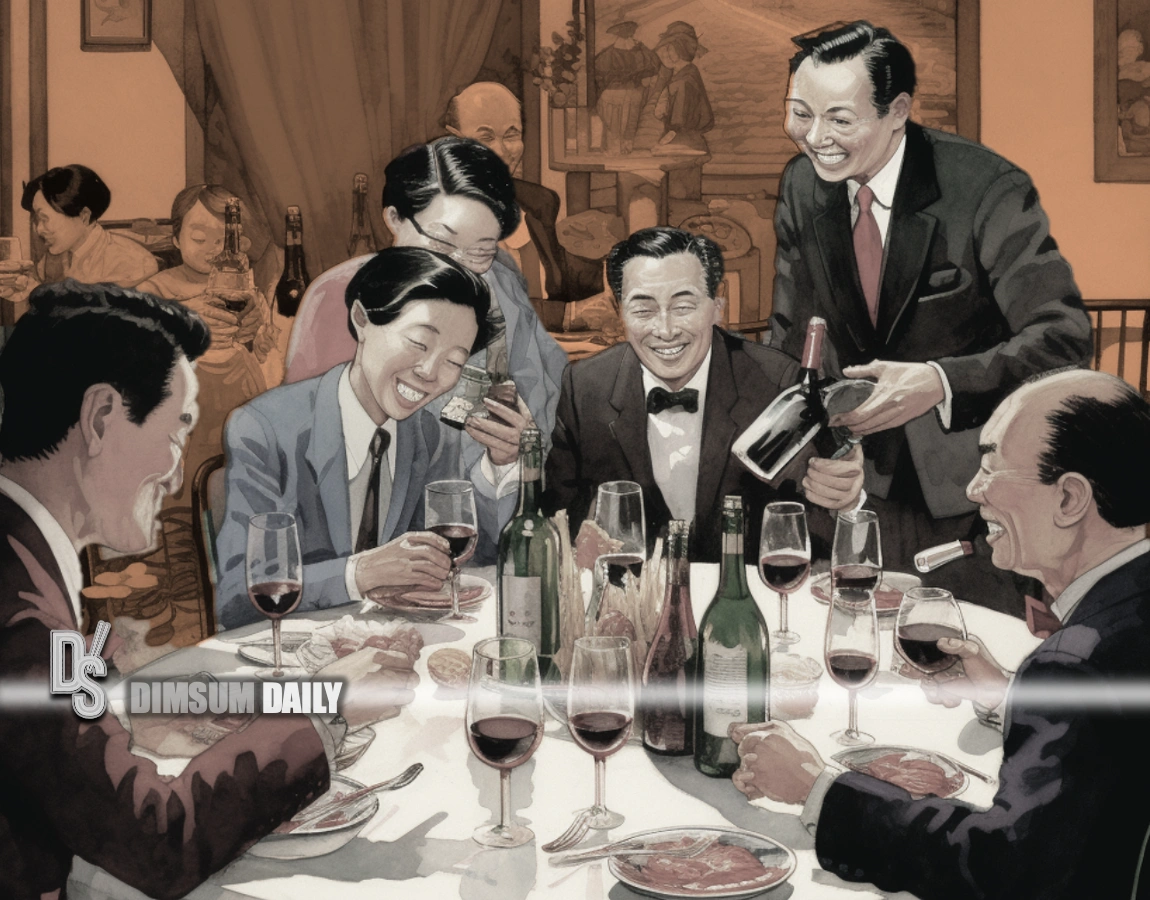
25th December 2024 – (Hong Kong) The holiday season descends upon Hong Kong’s glittering towers, and with it comes the annual parade of wine connoisseurs, those self-appointed arbiters of taste who’ve transformed the simple pleasure of fermented grape juice into a baroque performance of social status. In the city’s most exclusive clubs and restaurants, these seasonal sommeliers are staging their yearly production of swirling, sniffing, and pontificating about “notes” and “bouquets” with all the gravitas of a Shakespearean soliloquy.
As Seneca wisely observed two millennia ago, “You are nothing more than a filter.” Yet here we are, watching Hong Kong’s elite spend small fortunes on wines they likely can’t truly distinguish from bottles a fraction of the price. The city’s wine cellars have become the new temples of conspicuous consumption, where a single bottle of Château Lafite can cost more than a working-class family’s monthly salary.
In the climate-controlled caves of Central’s private clubs, middle-aged bankers compete to demonstrate their oenological expertise, describing wines in increasingly absurd terms. “Ah yes, I’m getting hints of wet limestone, summer truffles, and my grandfather’s leather armchair,” one might declare, while his companions nod sagely, none daring to admit they taste nothing of the sort.
The pandemic hasn’t dampened this enthusiasm for vinous one-upmanship; if anything, it’s intensified it. While much of the world struggled, Hong Kong’s wealthy simply shifted their wine tastings to private homes, where collections worth millions gather dust in custom-built cellars. The irony of storing wine worth more than most people’s homes in a city with a housing crisis appears lost on these collectors.
This peculiar breed of wine collectors has transformed into something more concerning than mere enthusiasts. They are no longer just purchasing wine for enjoyment; instead, they seek liquid trophies acquired through auctions at Sotheby’s and Christie’s, with each bottle representing a calculated display of their perceived sophistication and wealth. Amidst the festive season, as Victoria Harbour glimmers with Christmas lights, these self-proclaimed connoisseurs are preoccupied with organising extravagant tastings, where price tags take precedence over the actual contents of the bottles.
Consider the absurdity of Hong Kong’s wine auction scene, where bottles of 1982 Bordeaux trade hands for prices that could fund a child’s university education. The buyers often have no intention of ever drinking these wines; they’re simply participating in an elaborate financial game, treating vintage wines as though they were stocks or bonds. Seneca would surely have found dark humour in watching these modern merchants essentially trafficking in expensive vinegar.
The ritualistic aspect of wine appreciation in Hong Kong has reached almost religious proportions. At high-end establishments in Lan Kwai Fong and SoHo, sommeliers perform their duties with the solemnity of high priests, while diners genuflect before leather-bound wine lists thick enough to stop bullets. The ceremony of tasting – the precise angle of the glass tilt, the approved duration of the swirl, the depth of the appreciative sniff – has become more choreographed than a Cantonese opera.
What’s particularly galling is how this wine snobbery has infected the city’s broader drinking culture. Young professionals, eager to demonstrate their sophistication, now feel compelled to memorise wine regions and vintages as if their careers depended on it. Heaven forbid someone should simply order a glass of house red and actually enjoy it without providing a doctoral dissertation on its provenance.
During this season’s round of corporate Christmas parties, watch as middle managers desperately try to impress their superiors with their wine knowledge, regurgitating facts memorised from wine apps while secretly longing for a simple beer. The pressure to perform wine expertise has become yet another burden in a city already crushed under the weight of social expectations.
The economic absurdity reaches its zenith during the holiday season, when Hong Kong’s wine merchants gleefully exploit this manufactured prestige. A bottle of mediocre champagne, rebranded with a “limited edition” Christmas label, suddenly commands a price that would make a Michelin-starred chef blush. The same wine enthusiasts who lecture endlessly about authenticity and tradition fall prey to these marketing gimmicks with remarkable consistency.
As Seneca might observe if he were to visit a Hong Kong wine dinner today: “You spend a fortune to impress people you don’t like, drinking wine you can’t truly appreciate, to maintain a status you haven’t earned.” The philosopher’s words sting with particular relevance as we witness corporate warriors competing to display their wine credentials like peacocks strutting their plumage.
The pandemic, rather than fostering humility, has only intensified this vinous arms race. Virtual wine tastings became the new status symbol, with executives showcasing their home cellars via Zoom while discussing the “minerality” of wines they ordered through WhatsApp. The authentic connection that wine traditionally fostered between people has been replaced by digital peacocking and remote one-upmanship.
Most telling is the emergence of wine-focused social media influencers in Hong Kong, who turn every cork-pulling into a performance piece. Their carefully curated Instagram feeds feature bottles positioned just so, with Victoria Harbour or the ICC building providing the requisite backdrop. These digital wine shamans attract followers desperate to learn the secret handshake of oenological acceptance.
The approaching New Year amplifies this madness. Already, the city’s wine merchants are promoting “investment-grade” champagnes for countdown parties, where bottles costing more than a monthly mortgage payment will be sprayed around rooms in displays of conspicuous consumption that would make even the most hardened investment banker wince.
Yet beneath this sparkling facade lies a hollow core. Many of these self-proclaimed wine experts can’t distinguish between a $100 and $1,000 bottle in blind tastings – numerous studies have proven this repeatedly. The emperor’s new clothes are, it seems, filled with expensive wine that tastes remarkably similar to its humble cousins.
The true irony reveals itself in the city’s private dining rooms this Christmas season, where Hong Kong’s elite gather to perform their elaborate wine rituals. Watch closely as they pontificate about terroir and vintage variations, while their expensive bottles sit largely unconsumed, the participants too busy photographing labels for their WeChat moments to actually enjoy the wine.
Seneca’s wisdom echoes across two millennia: “What difference does it make how much is in the jug? The important thing is the effect it has on your mind.” In Hong Kong’s case, the effect seems to be a collective delusion that confuses price tags with pleasure and status with satisfaction. The city’s wine culture has become a perfect metaphor for its broader materialistic tendencies – all crystal glass and no substance.
As we approach the New Year, perhaps it’s time for Hong Kong’s wine enthusiasts to embrace a more authentic relationship with their chosen beverage. The true pleasure of wine lies not in its price or prestige, but in its ability to bring people together, to enhance a meal, to create moments of genuine connection. A $20 bottle shared with real friends holds more value than a $2,000 trophy gathering dust in a temperature-controlled vault.
This holiday season, as Hong Kong’s wine snobs gather in their climate-controlled cellars to compare bottle scores and investment returns, they might do well to remember that wine, at its heart, is simply fermented grape juice. Its true value lies not in the label or the price tag, but in the moments it helps create and the conversations it sparks. As Seneca reminds us, we are indeed all filters in the end – but some of us are considerably more expensive filters than others, with no discernible improvement in function.
Perhaps the most meaningful wine experience isn’t found in the prestigious tastings or auction houses of Central, but in the simple pleasure of sharing a bottle with those who matter, without pretence or performance. In a city obsessed with status and face, that might be the most radical act of all – to drink wine not as an investment or a statement, but simply for the joy of it.
As the Christmas lights fade and the New Year approaches, Hong Kong’s wine connoisseurs might consider that their elaborate ceremonies and expensive collections are, in the end, just another manifestation of the city’s endless status games. The truly sophisticated drinker might be the one who can admit that sometimes, the best wine is simply the one in your glass, shared with good company – price tag and parker points be damned.